







Award-winning rhubarb collection
rhubarb

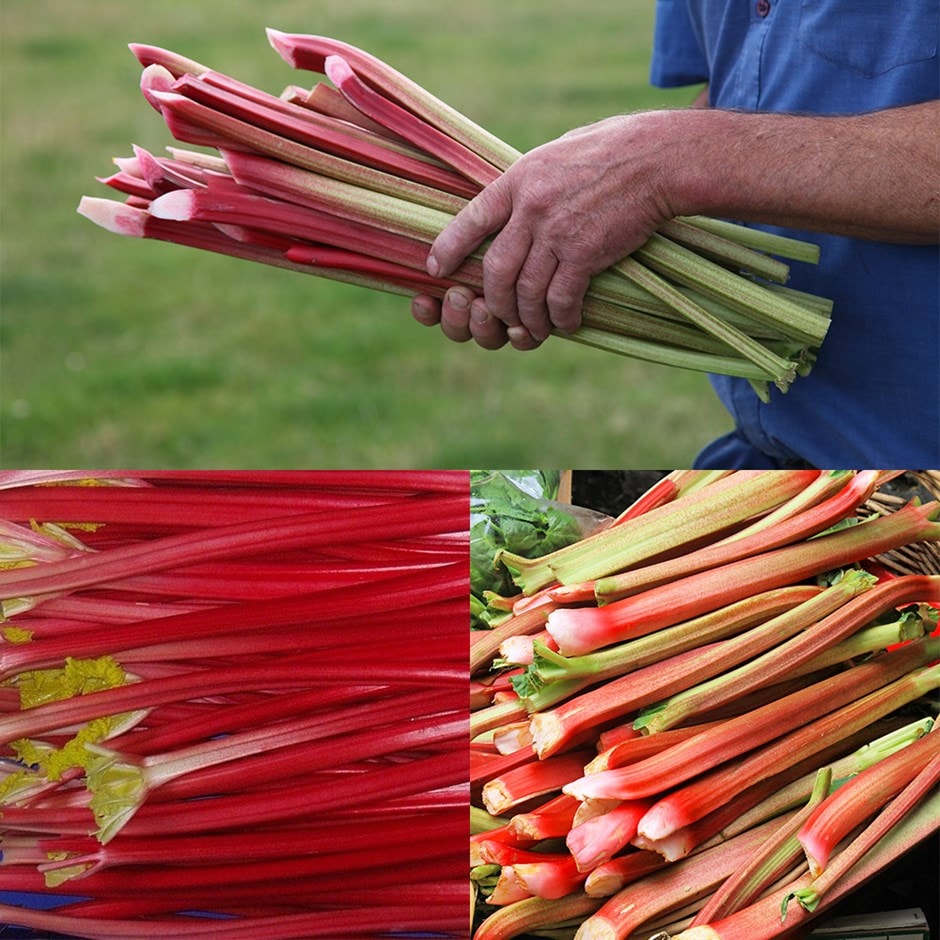
Much-loved for their edible stalks, which can be used to make pies and crumbles, these plants are also decorative enough to be incorporated into a mixed border.
How to care for Award-winning rhubarb collection:
Rhubarb crowns should be unpacked and planted within a few days of arrival. Choose a sunny spot with fertile, moist but well-drained soil, avoiding heavy, waterlogged areas. Prepare the bed by removing weeds and digging in composted manure.
Plant crowns 75cm-1m (2½-3ft) apart, with dormant buds just below the soil surface, and keep well watered. Remove old yellow leaves and any flowering stalks, but do not harvest stems in the first year. From the second year, harvest only a third to half of the stems, leaving the rest to mature, and continue harvesting through late spring to mid-late summer.
Apply composted manure in spring and sulphate of ammonia in summer, taking care not to cover the crown.
If you want an early (usually more tender) crop of rhubarb, you can 'force' some early cultivated varieties such as 'Timperley Early'. Cover a healthy crown in mid-winter with a rhubarb forcer or tall bucket. This can be insulated (which will speed up the process even more), by packing some straw or compost around the outside of the lower part of the forcer. The shoots will soon appear and these should be harvested within 2-4 weeks. A crown that has been forced, should be allowed to produce its crop naturally in the following year.
Plant crowns 75cm-1m (2½-3ft) apart, with dormant buds just below the soil surface, and keep well watered. Remove old yellow leaves and any flowering stalks, but do not harvest stems in the first year. From the second year, harvest only a third to half of the stems, leaving the rest to mature, and continue harvesting through late spring to mid-late summer.
Apply composted manure in spring and sulphate of ammonia in summer, taking care not to cover the crown.
If you want an early (usually more tender) crop of rhubarb, you can 'force' some early cultivated varieties such as 'Timperley Early'. Cover a healthy crown in mid-winter with a rhubarb forcer or tall bucket. This can be insulated (which will speed up the process even more), by packing some straw or compost around the outside of the lower part of the forcer. The shoots will soon appear and these should be harvested within 2-4 weeks. A crown that has been forced, should be allowed to produce its crop naturally in the following year.
What's included:
In each collection you will receive one crown of each of the following: varieties:
- rhubarb 'Timperley Early': As its name suggests, 'Timperley Early' is usually one of the first varieties to be harvested in the season (often as early as February) - but it is also suitable for forcing if you want an even earlier crop. Its red-based pink stems are succulent, and have a delicious flavour. Grows to 45cm.
- rhubarb 'Valentine': This vigorous rhubarb is noted for its super-sweet, greenish red stalks, which when cooked, are tender and juicy, while still retaining their colour. It will also reliably produce a high yield. Grows to 45cm.
- rhubarb 'Raspberry Red': A relatively recent rhubarb cultivar, 'Raspberry Red' produces thick, deep red stalks without the need for forcing. It is quite an early cropper and it has a deliciously sweet flavour. Grows to 45cm.
Position:
Full sun
Rate of growth:
Fast-growing
Soil:
Moderately fertile, moist, well-drained soil
Hardiness:
Fully hardy
-
 Humans/Pets: Harmful if eaten, except cooked leaf stalks

1 × collection | 3 crowns
was £17.95
now £15.26
£5.09 each
In stock
(delivery within 3-4 working days)
(delivery within 3-4 working days)
2 + 1 FREE collections | 9 crowns
was £35.90
now £30.51
£5.09 each
In stock
(delivery within 3-4 working days)
(delivery within 3-4 working days)
1


