







Paeonia Evie Jane ('Smithopus7') (Garden Candy Series)
intersectional paeony or ITOH peony



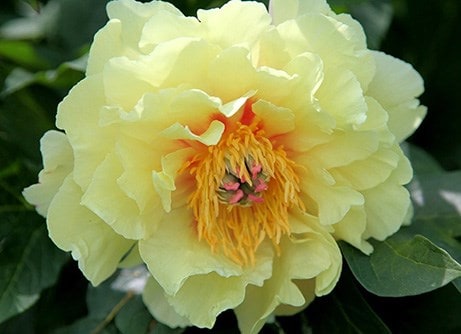
Displaying stunning semi-double blooms that can reach up to 25cm (10in) across, this eye-catching peony captivates with its pale rosy red flowers which hide a deeper raspberry centre, are elegantly nestled close to the lush foliage.
Compact and mounding in habit, these intersectional peonies require no staking and maintain their tidy, rounded shape even after blooming has finished. Resistant to both deer and mildew, these long-lived plants are low-maintenance and thrive best with at least six hours of sunlight, making them a remarkable addition to any garden.
Paeonia ‘Evie Jane’ also serves as an excellent source of cut flowers, enhancing floral arrangements with its striking appearance.
All of our peonies are field grown. We supply potted plants throughout the year, and subject to availability during the dormant winter months, we also offer bare-root plants (or tubers). If buying a potted plant, please keep in mind that some of the compost may still be a little loose, falling away when the plant is removed from the pot.
Compact and mounding in habit, these intersectional peonies require no staking and maintain their tidy, rounded shape even after blooming has finished. Resistant to both deer and mildew, these long-lived plants are low-maintenance and thrive best with at least six hours of sunlight, making them a remarkable addition to any garden.
Paeonia ‘Evie Jane’ also serves as an excellent source of cut flowers, enhancing floral arrangements with its striking appearance.
All of our peonies are field grown. We supply potted plants throughout the year, and subject to availability during the dormant winter months, we also offer bare-root plants (or tubers). If buying a potted plant, please keep in mind that some of the compost may still be a little loose, falling away when the plant is removed from the pot.
How to care for Paeonia Evie Jane ('Smithopus7') (Garden Candy) (PBR):
In the early spring, our potted bare root plants can be lightly rooted so can be kept in their pots for a few weeks, or planted out, avoiding frosty or waterlogged conditions taking care not to damage the emerging roots. Plant into well-prepared soil enriched with plenty of organic matter, and like herbaceous peonies, make sure that the highest bud on the crown is no deeper than 5cm (2in) below the soil surface as this will reduce flowering. In growth, keep well fed and watered, and remove spent flowers after they have faded.
In each subsequent spring, apply a balanced slow-release fertiliser around the base of the plant and lightly mulch with well-rotted compost or manure but not too deeply as this can smother the roots and reduce blooming.
Older stems have a tendency to become brittle and snap so cut these back by a third or to the ground in autumn every two or three years. Tree peonies are deep-rooted, and do not make good plants for containers.
In each subsequent spring, apply a balanced slow-release fertiliser around the base of the plant and lightly mulch with well-rotted compost or manure but not too deeply as this can smother the roots and reduce blooming.
Older stems have a tendency to become brittle and snap so cut these back by a third or to the ground in autumn every two or three years. Tree peonies are deep-rooted, and do not make good plants for containers.
Flowering period:
- Jan
- Feb
- Mar
- Apr
- May
- Jun
- Jul
- Aug
- Sep
- Oct
- Nov
- Dec
Eventual height:
0.9m
Eventual spread:
0.8m
Position:
Full sun / light shade
Rate of growth:
Average
Soil:
Moderately fertile, moist, well-drained soil
Hardiness:
Fully hardy
-
 This perennial dies back to below ground level each year in autumn, then fresh new growth appears again in spring.

-
Pets: Skin irritant
3 litre pot
£49.99
available to order from late spring
Unavailable
1


