










Rosa Ferdinand Pichard | Hybrid Perpetual Rose
rose Ferdinand Pichard (hybrid perpetual)


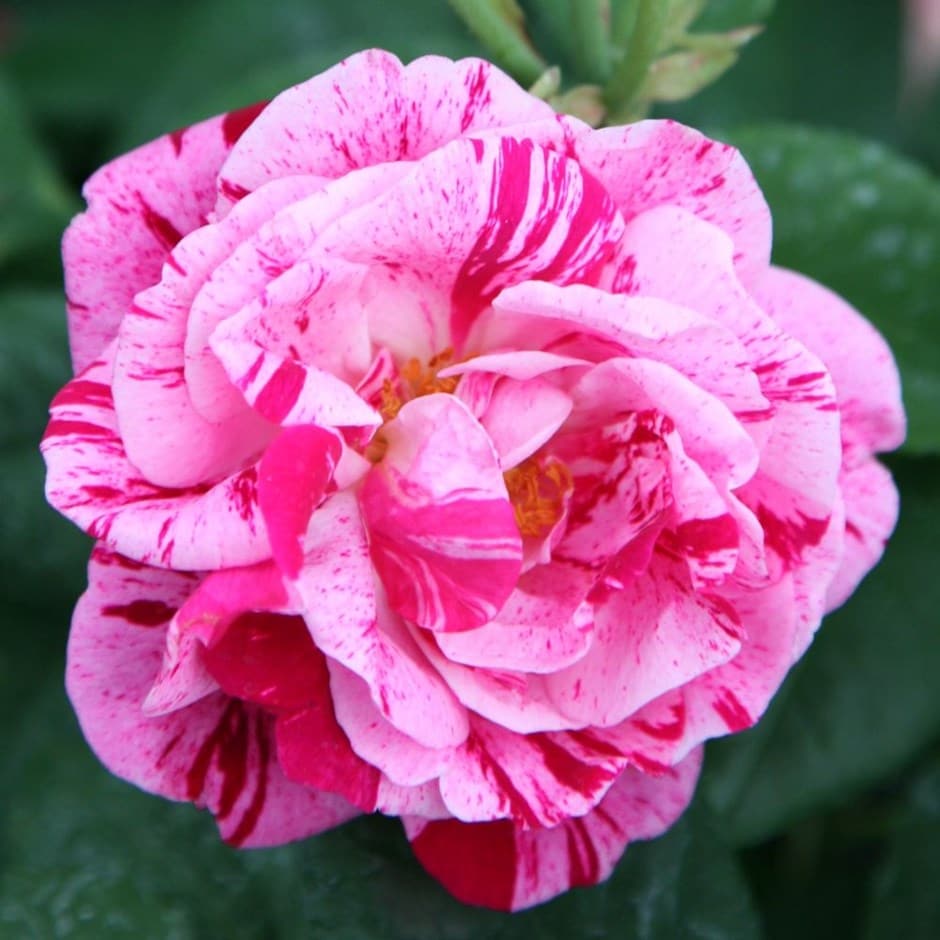
One of the finest striped roses, producing double, pink flowers that are clearly striped with crimson and purple. This hybrid perpetual rose has an upright yet compact form with prickly stems and dark green leaves. Rosa 'Ferdinand Pichard' is a good repeat-flowering rose with richly scented flowers.
All our roses are grown in an open field and then dug up when the weather conditions are right in October or November. Some suppliers send out their roses as 'bare root' plants (i.e. without pots or compost), but we pot ours up as it helps to keep the roots hydrated and in good condition. As they are dormant throughout the winter, they will not produce any new roots until spring, so don't be surprised if the compost falls away from the roots when you take them out of their pots.
The roses can be kept in their pots throughout the winter provided they are kept well fed and watered, however ideally they should be planted out as soon as possible. They will already have been cut back so no further pruning will be required, apart from snipping off any tips that have died back. Routine pruning can begin in late winter the year after planting.
All our roses are grown in an open field and then dug up when the weather conditions are right in October or November. Some suppliers send out their roses as 'bare root' plants (i.e. without pots or compost), but we pot ours up as it helps to keep the roots hydrated and in good condition. As they are dormant throughout the winter, they will not produce any new roots until spring, so don't be surprised if the compost falls away from the roots when you take them out of their pots.
The roses can be kept in their pots throughout the winter provided they are kept well fed and watered, however ideally they should be planted out as soon as possible. They will already have been cut back so no further pruning will be required, apart from snipping off any tips that have died back. Routine pruning can begin in late winter the year after planting.
How to care for Rosa Ferdinand Pichard:
If planting in winter, choose a frost-free spell when the soil is not frozen. Roses are quite deep-rooted plants so dig a deep hole roughly twice as wide as the plant's roots and mix in a generous amount of composted organic matter. A top-dressing of a general purpose fertiliser can be worked into the surrounding soil and we also recommend using Rose Rootgrow at this stage to encourage better root development. This is particularly important when planting into a bed where roses have previously been grown as Rose Rootgrow is said to combat rose sickness (aka replant disease).
Remove the plants from their pots and gently spread out the roots before placing them in the centre of the hole. Try to ensure that the 'bud union' (the point where the cultivated rose has been grafted onto the rootstock, and from where the shoots emerge) is at soil level. You can judge this quite easily by laying something flat, like a spade handle or bamboo cane, across the top of the hole. When they are at the right height, back-fill the hole, firming the soil down gently before watering the plant well.
Water generously until well established, and apply a specialist rose fertiliser (following the manufacturer's instructions) each spring. They will also benefit from a generous mulch of composted farmyard manure in spring, but make sure this is kept away from the stems.
This shrub rose flowers best on older wood and only needs light, formative pruning, best carried out from late autumn through to early spring while the plant is dormant, avoiding periods of hard frost. Hard pruning should be avoided unless absolutely necessary, as this can spoil the plant’s natural shape. While wearing gloves, remove any dead, damaged, diseased or congested stems entirely, and if the centre becomes overcrowded, take out one or two of the oldest stems at the base. If growth becomes leggy, new shoots can be encouraged by cutting one or two stems back to around 10-15cm (4-6in) above ground level.
Remove the plants from their pots and gently spread out the roots before placing them in the centre of the hole. Try to ensure that the 'bud union' (the point where the cultivated rose has been grafted onto the rootstock, and from where the shoots emerge) is at soil level. You can judge this quite easily by laying something flat, like a spade handle or bamboo cane, across the top of the hole. When they are at the right height, back-fill the hole, firming the soil down gently before watering the plant well.
Water generously until well established, and apply a specialist rose fertiliser (following the manufacturer's instructions) each spring. They will also benefit from a generous mulch of composted farmyard manure in spring, but make sure this is kept away from the stems.
This shrub rose flowers best on older wood and only needs light, formative pruning, best carried out from late autumn through to early spring while the plant is dormant, avoiding periods of hard frost. Hard pruning should be avoided unless absolutely necessary, as this can spoil the plant’s natural shape. While wearing gloves, remove any dead, damaged, diseased or congested stems entirely, and if the centre becomes overcrowded, take out one or two of the oldest stems at the base. If growth becomes leggy, new shoots can be encouraged by cutting one or two stems back to around 10-15cm (4-6in) above ground level.
Flowering period:
- Jan
- Feb
- Mar
- Apr
- May
- Jun
- Jul
- Aug
- Sep
- Oct
- Nov
- Dec
Eventual height:
2.5m
Eventual spread:
1.5m
Position:
Full sun
Rate of growth:
Average
Soil:
Moderately fertile, moist, well-drained soil
Hardiness:
Fully hardy
-
 This rose is deciduous so it will lose all its leaves in autumn, then fresh new foliage appears again each spring.

-
Humans/Pets: Fruit are ornamental - not to be eaten


